Lisa Thayer

The Women at the Cross of Jesus

8:00 AM

 Tuesday, March 23, 2021


Next week is Holy Week and we are preparing our hearts for the Resurrection of our Lord Jesus Christ.  I hope you find my post something to ponder about, much like we have heard these women did.  


I found it difficult to figure out who to write about.  There are three Mary’s who were at the cross of Jesus and each come from a different background.  


Mary, the mother of Jesus, was called “favored”; her heart was already in tune with God when the angel visited.  It was arranged for her to be married to Joseph.  Joseph had four visits from the angel of God, which shows how favored he was as well.  This Mary was young, in terms of age, possibly 12-14 years old when she had her first encounter with Jesus.  Throughout her lifetime, she had numerous encounters with our Lord, yet it did not make believing any easier.  


Mary, Mary’s older sister, followed Jesus as she discovered who He was in the early stages of his ministry in their small village.  She may never have followed Him, had she not been associated with Him through family ties.


Mary, of Magdela, was hurt, broken and empty when she bumped into Jesus.  She was healed by Him in radical ways.  We read about what the seven demons may have been here.  But this Mary was capable of using her financial stability to support Jesus’ ministry.  This enabled her to hear His message and follow Him in ways His own mother and aunt may not have been able to.


These three Mary’s were normal, every-day kind of women, just like you and I.   I have shared this link a couple of times recently because it explains how the role of women changed from Old Testament times until the times of Jesus.  Jesus’ relationship with women was so counter-cultural, we see how it opened the doors for the Good News to spread through women.


We are sharing a bit about these women this week before Holy Week, to help us prepare our hearts for Resurrection Sunday.  These days ahead are difficult for me, because, if I’m honest, I don’t always resemble what I claim to be.  A Christian.  And this journey called life, has many challenges, and unless we are not at the foot of the cross, being covered by His blood, on a daily basis, we are probably pushing and shoving to sit right next to Him.


There’s the book called “The Calvary Road”, which I like to read during Lent because it helps me examine myself.  Lent is the Christian season of spiritual preparation before Easter. In Western churches, it begins on Ash Wednesday. During Lent, many Christians observe a period of fasting, repentance, moderation, self-denial, and spiritual discipline. The purpose of the Lenten season is to set aside time for reflection on Jesus Christ—to consider his suffering and his sacrifice, his life, death, burial, and resurrection.”  (What is Lent).  What I have found is that we can do it all wrong and “The Calvary Road” helps me to navigate through this season with my eyes on Jesus and not myself.  (I can’t help but hear Toby Keith’s song, “What I like about me”)


I digress.  



I had this passage on my refrigerator because I struggle, and I don’t always love as I have been loved.  We need to learn to call sin, what it is -- sin --, and go with it to the cross and trust the Lord Jesus to cleanse us from it.  We can be quick see the speck in each other’s eye and not the beam in our own.  We seem to have a distorted view of someone’s wrong and it disables us from seeing them as they truly are - Beloved of God!
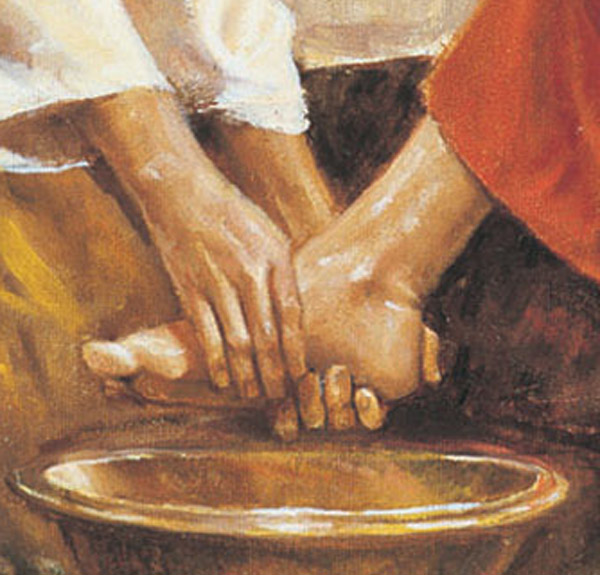


I used to have a picture similar to this on my desk at work to help me remember that I am first and foremost, a bondservant to Christ.  I need to reflect Him, and no one else.  Do you remember the story in Luke 17:7-10 where the servant had all kinds of things stacked one on top of the other, and yet he did it all, expecting nothing else?  How quickly do we spit and sputter at the thought of doing something else?  AND not getting thanked for it!  But also remember - we cannot boast for all these things we just did!  Self-denial can be hard!  Besides, if we are honest with ourselves, none of what we have is ours - it’s all a gift from God!


There’s power in the blood of the lamb.  “And through him, God reconciled everything to Himself.  He made peace with everything in heaven and on earth by means of Christ’s blood on the cross.”  (Colossians 1:20 NLT)  Jesus is the lamb; meek and lowly in heart, gentle and unresisting, and all the time surrendering His own will to the Father’s (Matt 11:29; John 6:38).  Can you see the humility and self-surrender of the lamb?  This is the disposition that gives the Blood it’s power with God.   “Just think how much more the blood of Christ will purify our consciences from sinful deeds[a] so that we can worship the living God. For by the power of the eternal Spirit, Christ offered himself to God as a perfect sacrifice for our sins.”  (Hebrews 9:14)


It’s humility, lamb-likeness, the surrender of our wills to God, that God is looking for in us.  Are you willing?  To let go of standing up for yourself and resisting making comments to others?  All those trivial matters?


In the last chapter of The Calvary Road, the author helps us see just how easy it is to be self-righteous.  In Luke 18:9-14 we are reminded of the Pharisee’s attitude, however, what about when we read that story and think to ourselves how lucky we are that we aren’t like the Pharisee?  Jesus says, “From within, out of the heart of men, proceed evil thoughts, adulteries, fornications, murders, thefts, covetousness, wickedness, deceit, lasciviousness, an evil eye, blasphemy, pride, foolishness” (Mark 7:20-23) “The simple truth is that the only beautiful thing about the Christian is Jesus Christ.  God wants us to recognize that fact as true in our experience, so that in true brokenness and self-despair we shall allow Jesus Christ to be our righteousness and holiness and all in all - and that is victory.”


I cannot help but think of Mary the mother of Jesus, and recall all the people she bumped into along her journey .  There were those who prophesied.   She heard Joseph teach young Jesus from scripture.   And the fact that at such a young age she was chosen to carry the baby Jesus into the world, and yet there were times Jesus told her to wait (John 2:1-12).  What about the times she must have felt ignored and unknown by her son (Matthew 12:48).  But we see her come to Jesus at the foot of the cross, to be washed in His blood and cleansed of her own sin.  Are you willing to sit at the foot of the cross?


The other Mary’s too had to be humble enough to meet Jesus at the cross.  None of what happened to them - their spiritual awakening, had anything to do with themselves.  It’s all about Jesus.  


He humbled Himself to the manger,

And even to Calvary’s tree;

But I am so proud and unwilling, 

His humble disciple to be.


He yielded His will to the Father,

And chose to abide in the Light;

But I prefer wrestling to resting, 

And try by myself to do right.


Lord break me, then cleanse me and fill me

And keep me abiding in Thee;

That fellowship may be unbroken,

And Thy Name be hallowed in me.


(from The Calvary Road)


Blessings for a reflective Holy Week,

Lisa

Life and Times of Lois and Eunice

The Life and Times of Lois and Eunice

7:00 AM

 Tuesday, March 16, 2021


There is not a lot of information in Scripture regarding Lois and Eunice, but what we do know is an encouragement to all mothers who want to raise their children to love God!


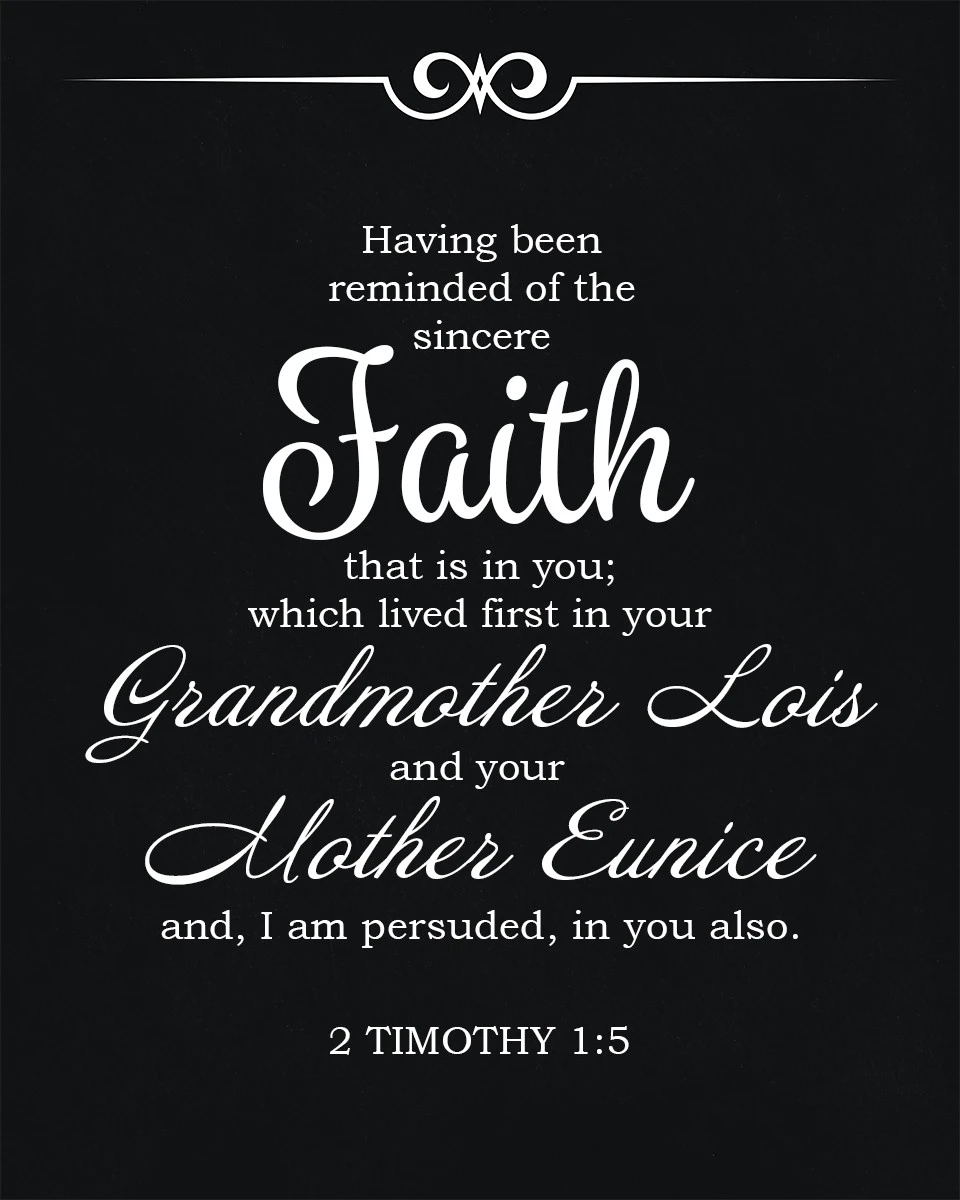
Lois and Eunice were a mother/daughter team that raised up a man of God, Timothy, who was the Apostle Paul’s most trusted companion and disciple. It is only in Acts 1:6 and 2 Timothy 1:5 that we find record of these women, but what Paul says about them is something I would like people to say about me.  In 2 Timothy 1:5, Paul writes,” I have been reminded of your sincere faith, which first lived in your grandmother Lois and in your mother Eunice and, I am persuaded, now lives in you also.”  Have you ever considered how you can pass on your faith to the next generation?


Lois


The name Lois means “agreeable” or “desirable”.  And she appears to have lived up to her name!  The Apostle Paul praises her in his second  letter to Timothy as one who passed on the mantle of faith to both her daughter and her grandson. While there are numerous grandmothers mentioned in the Bible, 2 Timothy is the only place where the term “grandmother” is actually used.


Lois must have been a devout Jew who had obviously instructed her daughter and grandson in the Old Testament Scriptures.  The Scripture is silent about Lois’ husband, yet we do know that she gave her daughter a Greek name, which might indicate that he himself was Greek.  The family lived in Lystra, among people who worshipped the gods of Greece, yet she faithfully raised a daughter who loved God and helped raise a grandson who shared that love.


Eunice

From what we are given in Scripture, Eunice was also a devout Jew before coming to Christ. She has a Greek name that is derived from the name Nike, which was the Greek goddess of victory.  Her name actually means “conquering well” and was a name expressive of a good or happy victory.  Eunice, too, lived up to her name.  She had victory over the immoral society in which she lived by raising a devout son.  We learn from Scripture, in Acts 16:1 that Eunice had married a Greek man, a gentile, therefore an unbeliever. To them was born a son, whom they named Timothy.  Nothing else is said about him, so many assume that he was dead by the time Eunice met the Apostle Paul.

The Family 

The family lived at Lystra, and it is likely that during Paul’s first visit to that city that Lois, Eunice, and Timothy  were all  converted to the Christian faith.  There is no doubt that their devout Jewish faith and knowledge of the Old Testament Scriptures prepared their hearts to hear the words of Paul regarding eternal life through Jesus Christ. 

When Paul returned to Lystra on his second missionary tour, he found the young man highly spoken of by the little group of Christians in that city.  Timothy’s abilities and promise is what made Paul decide to make him a missionary companion.  Years later, Paul was in the prison in Rome awaiting trial and likely to be executed, he wrote his second letter to his beloved companion, calling to remembrance the faith Timothy had shown, and reminding him that this same faith was first in his grandmother Lois and his mother Eunice. Again, he says, to Timothy, “From a child, you have known the holy Scriptures”.

I cannot overlook the compelling feature from Scripture of Eunice and Lois, and that is their religious influence on Timothy.   Since his father is not mentioned in connection with Timothy’s faith, it is apparent that these two godly women trained him up so that he both knew and loved God’s word.  

Timothy

The name Timothy means “one who fears God”, a name obviously picked by his faithful mother.  Grandmother and mother had no doubt been the teachers of his youth.  His ability to be the companion and co-worker of Paul can only be attributed to his upbringing and example given him by these two noble women.  It was from them also that the young Timothy derived his first impressions of Christian truth; for Paul calls to remembrance the earnest faith which first dwelt in them.

The record of Timothy demonstrates the value of positive Christian training in the home.  Lois and Eunice took the responsibility to pass on their faith very seriously and as a result they  raised up a young man to become a servant of Christ.  For this, they have gone down in history as outstanding mothers and great women of faith.

As women, we are all equipped to plant seeds of faith.  Some people are great teachers and can lead women’s worship groups.  Other women are amazing mother’s and grandmother’s, and lead in the home.  Some women are fantastic at being in the public eye and can be heard sharing their faith across the world via podcasts and videos.  Trust God when you are being led to share your faith to the next generation.


Lisa Thayer

The Life and Times of Dorcus {Acts 9}

8:00 AM

 Tuesday, March 9, 2021


The Life and Times of Dorcus


The Scripture record of Dorcus is limited to a few verses in Acts 9. Dorcas was also called Tabitha—Dorcas is a Greek name meaning “gazelle,” and Tabitha is the Aramaic rendering of the same name. Dorcas, or Tabitha, was a charitable person who made things, especially clothing, for the needy in Joppa (gotquestions.org)  


The Bible is silent concerning the genealogy of Dorcas. What is known is that her home was at Joppa and she was associated with a small, poor Christian church.  Dorcus however, apparently had the means to serve her community as freely. 


The bible gives us only glimpses of her witness and work for Christ here in these few verses, yet she has influenced many by her good works. She is evidently a Christian, being called “a disciple”. It was through the ministry of Phillip that a Christian church was established in Joppa at an early date. From its very beginning, the church in Joppa was known as a center of fervent evangelism and a well-organized social service provider. 


Dorcas was “always doing good and helping the poor” (Acts 9:36). What is significant about the account of her life is that Dorcas not only thought up ways of relieving the needy, but she also carried out her plans! She knew what she could do and she DID it. She was a true “doer” of the Word. Among her good works was that of making clothes for widows and the needs of her church and community with her own hands. The clothes that Dorcas cut out and sewed represented Christian faith in action. She was not only willing to give financially, but she was willing to invest herself in the work of charity.


When Dorcas died, she left the church at Joppa grief-stricken. The church called for the Apostle Peter, who was in a neighboring city, to come to them. They obviously had heard of Peter’s recent contact with Aeneas and hoped that he might return their greatly-loved friend to them. When he got there he found that the widows Dorcas had helped had laid her out and prepared a powerful eulogy on the life and character of Dorcas by showing some of the many coats and garments which she made for them. We can see the old widows whose hands were too arthritic to hold the needle and too poor to pay others to make clothes for them.  They showed the warm garments Dorcas had made them to protect them from the cold winds which often swept in from the Mediterranean. And here were younger widows with little children who had been clothed by Dorcas. How could they ever find another friend like her?  Here's a short video you may enjoy.


Dorcas was given back to them by a great miracle!  Peter sent them all out and kneeled down and prayed. He spoke the words of power and authority and raised Dorcas from the dead, and presented her alive to the people at Joppa. Can you imagine?!  What joy to receive this blessed woman back from the dead and the word and works of God spread quickly.


Here’s where we all can learn a bit; while Dorcas was greatly loved and respected among the people of Joppa, it seems that she wasn’t conscious of the noble work she was doing and of its effect throughout history.  Dorcas did not strive to be a leader, but was content to stay in her own home and try to do all she could to serve the Lord. We can hold Dorcas as an example to all of us to look after the welfare of others. 


Lisa Thayer

The Life and Times of Mary, Mother of John Mark

7:00 AM


Tuesday, March 2, 2021

MARY, MOTHER OF JOHN MARK


We see yet again how women have a significant role in sharing the Gospel message.  The importance of hospitality is presented here, as  it was in the story of Martha of Bethany.  I hope you are gathering and pondering the value of women when it comes to sharing the love of Christ.

Mary, the mother of Mark who wrote the second gospel, is spoken of once in the book of Acts  (read her story here), yet this brief description of her is suggestive of her life and labors and you’ll see I make a few speculations. 

She is possibly the aunt or sister of Barnabas, the one-time companion of Paul  (Colossians 4:10).  This may account for Barnabas' choice of Mark as his companion—a selection over which Paul and Barnabas parted. Being related to Mary would account for the leadership among the people gathering in her large home. I read that Sir William Ramsay holds that the record of Mary in the book Acts was by Mark, which would account for the details of his mother’s large house becoming a well-known center of Christian life and worship. There is a legend to the effect that this same house was the scene of a still more sacred gathering when, in its upper room, Jesus observed the Lord’s Supper on the night of His betrayal.

And if that is indeed the case it would explain an obscure reference that we find only in Mark's Gospel. It is discovered in Mark’s account of the arrest of Jesus Mark 14:51-52.  Other translations tell us that he was wearing a linen sheet. So here is the speculation, that when Jesus and his apostles left the home they were meeting in, that young John Mark wrapped himself in a sheet and followed them, only to almost be caught by the guards who arrested Jesus, escaping with little more than his life.

If that was the case it would explain how we get the account of Jesus’ prayer and struggle in the garden, because we are told that the apostles were all asleep. So the speculation is that John Mark, probably just a young teen, followed the One who his mother worshipped and was hiding in the garden was able to witness and hear Jesus’ struggle.

Peter found his way to Mary’s home after his miraculous escape, for he knew that a group of believers had gathered there to pray for his release. Peter had a peculiar affection for this godly home. He called Mark, “his son” (1 Peter 5:13) -- a spiritual son, having led him to surrender his life to the Savior. 


The way in which the disciples met in Mary’s home is an example of her steadfastness and the bond of intimacy that existed between them. We see that Rhoda was one of the maids which  indicates that the household was considerably large, implying that Mary was a widow with financial means to maintain such a spacious home. As Barnabas her relative gave up his land for Christ, Mary gave up her Jerusalem home to be used as an infant church.

Mary was a woman of noble qualities and was loyal to her Christian ideals. At that time Christians were persecuted, yet she faced the consequences of sharing her home as a center of spiritual power and influence, and was self-sacrificing in time, effort and money to serve the Lord. 

As for Mark the evangelist, Mary’s son, he was deeply attached to his mother which was probably one reason why he returned to Jerusalem from Perga (Acts 13:13). He wanted to be near to the one who had meant so much in his life.  His faith had been formed and shaped by the faith of his mother.  Let us all be mothers, like Mary who have the character to be peculiar and confident in who Jesus is to shape the lives of our children and grand-children.

Blessings, 

Lisa


Lisa Thayer

The Life and Times of Martha of Bethany

7:00 AM

 Tuesday, February 16, 2021


Martha’s name is the feminine version of Lord or Master.  Some early writers have said she was the wife or widow of Simon the Leper and when he died, the house in Bethany became hers.  


Martha is the older sister to Mary and Lazarus and lived in a small village, called Bethany, just 2 miles from Jerusalem on the eastern slope of the Mount of Olives.


Last week I shared this amazing link to help us understand the shift in cultural norms from the Old Testament times to the New Testament times.  The role of women had drastically changed and women were no longer found out in public.  Their role was in the home.  And when Jesus shows up, He counter-culturally affirms women’s roles as disciples and invites Martha to join her sister Mary.


But Martha is older and more practical.  Her role as hospitality hostess fulfills the biblical command.  Gotquestions.org says this about hospitality:  


Hospitality can be defined as “the quality or disposition of receiving and treating guests and strangers in a warm, friendly, generous way.” In the New Testament, the Greek word translated “hospitality” literally means “love of strangers.” Hospitality is a virtue that is both commanded and commended throughout Scripture. In the Old Testament, it was specifically commanded by God: “When an alien lives with you in your land, do not mistreat him. The alien living with you must be treated as one of your native-born. Love him as yourself, for you were aliens in Egypt” (Leviticus 19:33-34, emphasis added).


Our culture seems to tell us Martha was an uptight, busybody - I beg to differ.  Martha’s ability to provide food and lodging for any sojourner was a highly valued expectation.  And Jesus and His disciples enjoyed their frequent visits to her home.


Luke 10 tells us:

At the Home of Martha and Mary

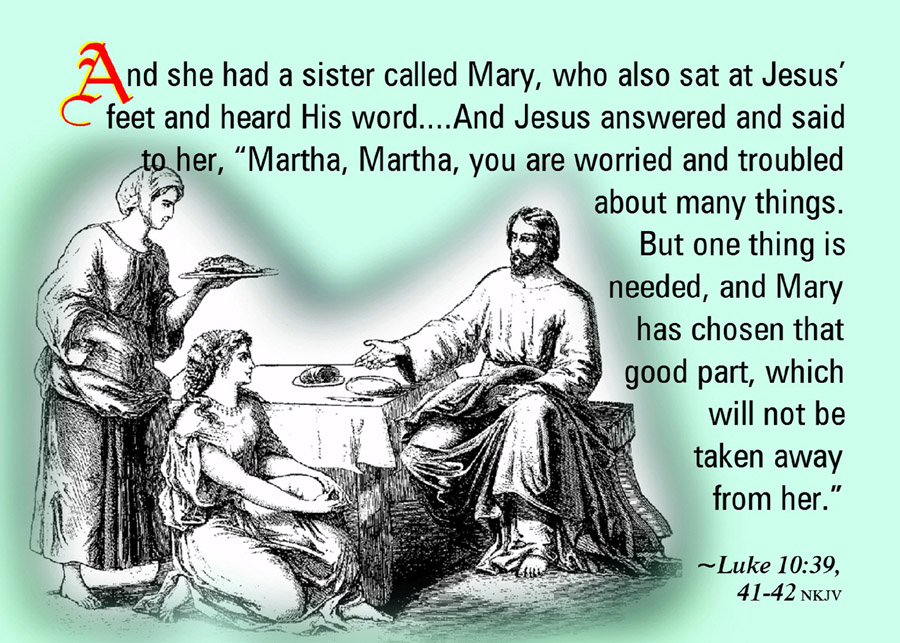
38 As Jesus and his disciples were on their way, he came to a village where a woman named Martha opened her home to him. 39 She had a sister called Mary, who sat at the Lord’s feet listening to what he said. 40 But Martha was distracted by all the preparations that had to be made. She came to him and asked, “Lord, don’t you care that my sister has left me to do the work by myself? Tell her to help me!”

41 “Martha, Martha,” the Lord answered, “you are worried and upset about many things, 42 but few things are needed—or indeed only one.[f] Mary has chosen what is better, and it will not be taken away from her.”

In a culture where Mary was expected to be hidden from men and behind closed doors, Jesus shows Martha that He recognized that she was working for Him, but that her household activities were hindering her spiritually - her inner communion with the Lord was hindered.  Scripture tells us she was ‘distracted’.  The New Living Translation for 1 Corinthains 7:35 says, I am saying this for your benefit, not to place restrictions on you. I want you to do whatever will help you serve the Lord best, with as few distractions as possible.”  But Martha was the one who managed all the household and served, she found herself with conflicting cares.  She loved Jesus and wanted all in the house to do their best for Him.  


What I find most important to notice about Martha, is that she takes her cares and concerns directly to Jesus.  She asked Jesus to tell Mary to help her.  And when Lazarus becomes ill, she sends word to Jesus to come.  And when He arrives, she goes to Him immediately.  She is always seeking Jesus.


When we look in John (the apostle of love) 11, we see just how much Jesus loved Martha.  Jesus wanted both Martha and Mary to learn that His delays were not denials; that He knows exactly when to display His power.  He knew that this was a death that would result in Him being glorified as the Son of Man.


So when Martha heard that Jesus was on His way, she went out to meet Him and left Mary in the house.  Martha’s tendency was to be blunt, but she also knew that Jesus could ask anything of God and He would give it.  Wow!  That’s some faith!  Immediately Jesus healed her broken heart by assuring her that her brother would rise again.  No explanation of His delayed arrival was given.  Jesus began right away to unfold the truth He meant both His delay and the death of Lazarus to convey.


Martha may have been kept at home, but she obeyed the scriptures.  Martha thought the resurrection of her brother was a far-off event, but Jesus lets her know that He is power by which the dead are raised.  And when He challenged her with “Do you believe this?” 


27 “Yes, Lord,” she replied, “I believe that you are the Messiah, the Son of God, who is to come into the world.”


Although scripture doesn’t say this, we come to understand these three titles of Jesus:


The Christ - The One of whom glorious things had been predicted as the anointed prophet, priest and king.


The Son of God - A confession of His deity, for this is a title pertaining not to His office or position, but to His nature and Person as the Only Begotten of the Father.


He that should come into the world - This was a common description of the Jews of Him who was at once the heart of prophecy, the object of the aspiration of all illuminated and reborn souls, and the desire of all nations.” (biblegateway.com)


The final time we see Martha is again at her home to celebrate the resurrection of Lazarus and as usual she was busy being hospitable.  Mary anointed the feet of Jesus and Martha raised no objection.  Martha’s service was the same, but her spirit was richly blessed.  She was no longer “distracted” over her tasks, nor mentally anxious.  She may have been bustling around serving food to the others, but she was calm, trustful and in full agreement of her sister’s act of love and devotion to Jesus.  Martha too, has chosen that good part which could not be taken from her.


The Church requires both Martha and Mary’s.  We must learn that secular service has its place.  We must be conscious that both serving and learning are duties in how we can honor God.  We can trust the Lord with all our cares, responsibilities and sorrows knowing that He is able to undertake it all for us.  And if His help appears to be delayed, we must remember that He is never before His time, and He never lags behind.  We must offer our best to Him who broke the alabaster box of His own body that heavenly forgiveness and fragrance might be ours.


Blessings,

Lisa


Lisa Thayer

The Life and Times of Mary of Bethany

8:00 AM

 Tuesday, February 9, 2021


Mary of Bethany is the sister of Martha and Lazarus.  I have read that there is some confusion that she is the same person as Mary of Magdala, however, the hometown indicates she is not.  And, Mary is not a prostitute.  


Bethany is a small village on the eastern slope of the Mount of Olives, about 2 miles from Jerusalem and a favorite place for rest and refuge for Jesus (Mark 11:11; Luke 22:39)


I decided to do a little further digging into the culture of the times of Mary’s life.  This site has some fantastic explanations of the changes from the Old Testament to the New Testament.  In Old Testament times, women were not limited to private roles, but somehow by the time of the New Testament, the role of women had drastically changed and for the worse.  Jesus radically changed this tradition by offering his teachings freely to anyone who would listen—women or men!  We see Him talking directly to women on several occasions.  The following are the three times we see scriptural evidence of Jesus with Mary of Bethany.


  1. Luke 10:38-42)  Here, Mary’s silence indicates a lack of concern for herself, especially for defending herself.  When we focus on Christ, He becomes our greatest passion and our tendency to self-absorption dims and fades.


  1. (John 11:38-44)  Jesus calls for Mary and she immediately leaves and rushes to meet Jesus.  So great is her love for Him and her desire to please and obey Him, that she leaves those who had come to comfort her to place herself in the arms of the greatest comforter.


  1. (John 12:1–8)  The third and final time we see Mary of Bethany is just days before Christ’s crucifixion.  A meal had been prepared, the resurrected Lazarus reclined at the table with Jesus and the disciples. At some point, Mary poured a jar of very expensive perfume on Jesus’ feet and wiped them with her hair. Despite criticism from Judas Iscariot about the waste of the costly substance, Mary said nothing. Mary again remained silent.  Jesus defends her, which He does, saying that she has kept this perfume for His burial and has done a beautiful act of service to Him.


We see two amazing things about Mary here from which we should pay attention.   First, she seems to know that the time of Jesus’ death on the cross was at hand, a fact that had escaped the disciples despite Jesus’ declaration three times of this truth. Mary was content with listening to her Lord and meditating on His words, while the disciples bickered about who would be greatest among them in the kingdom. By doing so, they missed the important truths Jesus was teaching them about His upcoming death and resurrection (Mark 9:30-35). How often do we miss spiritual truths because we are self-focused and overly concerned for our rewards, our status and our reputation among peers?


Second, we see in Mary a grounded conviction and confidence in her Lord, so much so that she is not compelled to defend herself in the face of criticism. How often are we quick to jump at the chance to justify ourselves in the eyes of others who criticize and mock us, particularly where our faith is concerned? But if we, like Mary, make sitting at the feet of Jesus and listening to Him our priority, we will have her depth of understanding, her passion for Christ, and her complete faith in His plan for our lives. We may not have Jesus sitting in our homes in person, but we have His Word, and from it we have all the knowledge and understanding we need to live a life of secure and confident faith like Mary of Bethany.


I find it rather interesting too that Mary’s name means ‘bitterness’.  Bitterness seems to be something our culture is dealing with a lot lately.  I know in my lifetime, I have witnessed women grow more bitter towards their roles as women.  We are now struggling with gender and women are desiring to become men.  Women will always be uniquely women and no amount of theorizing can change the fact that God created a male and a female equally in His image, equal in personhood, yet different in function.  God created us to complete each other, not compete with each other.  


Something we all need to remember is that culture and traditions are fallible and scripture is divine and infallible.  Jesus revealed the character of God to us and we learn what God thinks of us!


  • God made us women

  • God accepts us as women

  • God understands women

  • God loves women

  • God made women influential.  We influence our husbands, children, friends, co-workers and our community. 


Because God has wired us like this, He gives us a responsibility that only we can do.  Only women can model godly womanhood.  We have such a great example here in Mary of Bethany.  Three times we see Mary at the feet of Jesus - listening, expressing her faith and loving Him.  Jesus wants us to spend more time listening to Him than working.  He also desires that despite difficult circumstances, we remain faithful to Him.  And we aren’t afraid to express our deep love for Him.


Blessing,

Lisa