
Tuesday, December 29, 2020
This is a long post, but one I believe is important to understand. Please allow yourself some extra time to take it all in.
Have you ever walked out of a church service so emotionally moved that you knew you had to do something? I don’t remember how many times I heard this passage, but eventually it caused me to do something!
The story of the ten virgins is a story about division. Five are wise and five are foolish. All 10 are waiting. We spend a great deal of our lives waiting - we wait to get out on our own. We wait to get married. We wait to have children. We wait for them to grow and mature and move on. One of the characteristics of life which makes it worth living is this note of waiting. There must be something beyond - something worth waiting for. Otherwise life would become terribly purposeless.
These women were waiting for the coming of the bridgebroom - the ultimate message - they were waiting for the coming of Jesus Christ!
These women are convinced that Jesus will come again, just as He described it. They believe that this will not be done by earthly means brought about by men. They are all in agreement that only Jesus can accomplish this and they are hopeful that this coming will be very soon. These women are united in this expectation that Jesus is coming soon.
In their expectation of the coming of the bridegroom, they are all equally sincere and devoted. The only difference is five of them felt it would be wise to provide some extra oil.
This is the most significant part of this story. United in waiting for the bridegroom’s coming and all in agreement of the importance of oil and using it for its proper purpose - the giving of light. The slight difference was that five felt more was needed.
There’s no explanation for what delayed the bridegroom. It seems that there’s a hint from the Lord that His absence would be long extended. It also hints that there would be a demand for more oil. But the delay also shows how the 10 grew weary and fell asleep.
As we wait for Christ’s return, life here on earth goes on. It does not mean that we should be constantly peering up to heaven like some air-raid is coming. Or constantly discussing the Lord’s return. But while we wait, for many, it’s easy to forget. During this waiting and watching, normal activities occur.
While these wise and foolish maidens were sleeping, their thoughts got diverted. They were engaged in the normal activities of life. There’s no need to feel guilty if you have not been thinking of the Lord’s return. We have not failed because we have been busy with normal and necessary things. These maidens were waiting for the bridegroom - even while they slept.
But suddenly - Behold! The Bridegroom! The cry is sounded and all 10 are awakened. It is clearly evident that the problem which would soon confront them did not arise out of the fact that they had fallen asleep. They were awake in plenty of time to meet the bridegroom.
For many people, 2020 was an awareness of the Lord’s imminent return. We are aware that the grind and routine of life is not intended to go on forever.
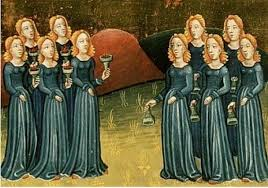
The crisis in the wisdom of the wise and the foolishness of the foolish is this - the long delay used up the oil and they have no more. And they appeal to the wise; “Give us some of your oil.” The reply of the wise indicates that the oil is not something that can be borrowed or loaned. Whatever it may represent, it is an individual matter.
We have all felt something of this in some crisis hour when we have found our resources unequal to the demand. We see someone else who is going through the same thing, and she appears unmoved and calm, well able to take the pressure. We may long to borrow some of her strength, but it’s impossible. In such an hour, each has what she has and nothing more.
So it is with these five foolish maidens. Their oil is gone and to their dismay they discover their need and there is a panicky rush to get more. But our Lord moves right on into the story, and the final movement is one of denial:
10 “But while they were on their way to buy the oil, the bridegroom arrived. The virgins who were ready went in with him to the wedding banquet. And the door was shut.
11 “Later the others also came. ‘Lord, Lord,’ they said, ‘open the door for us!’
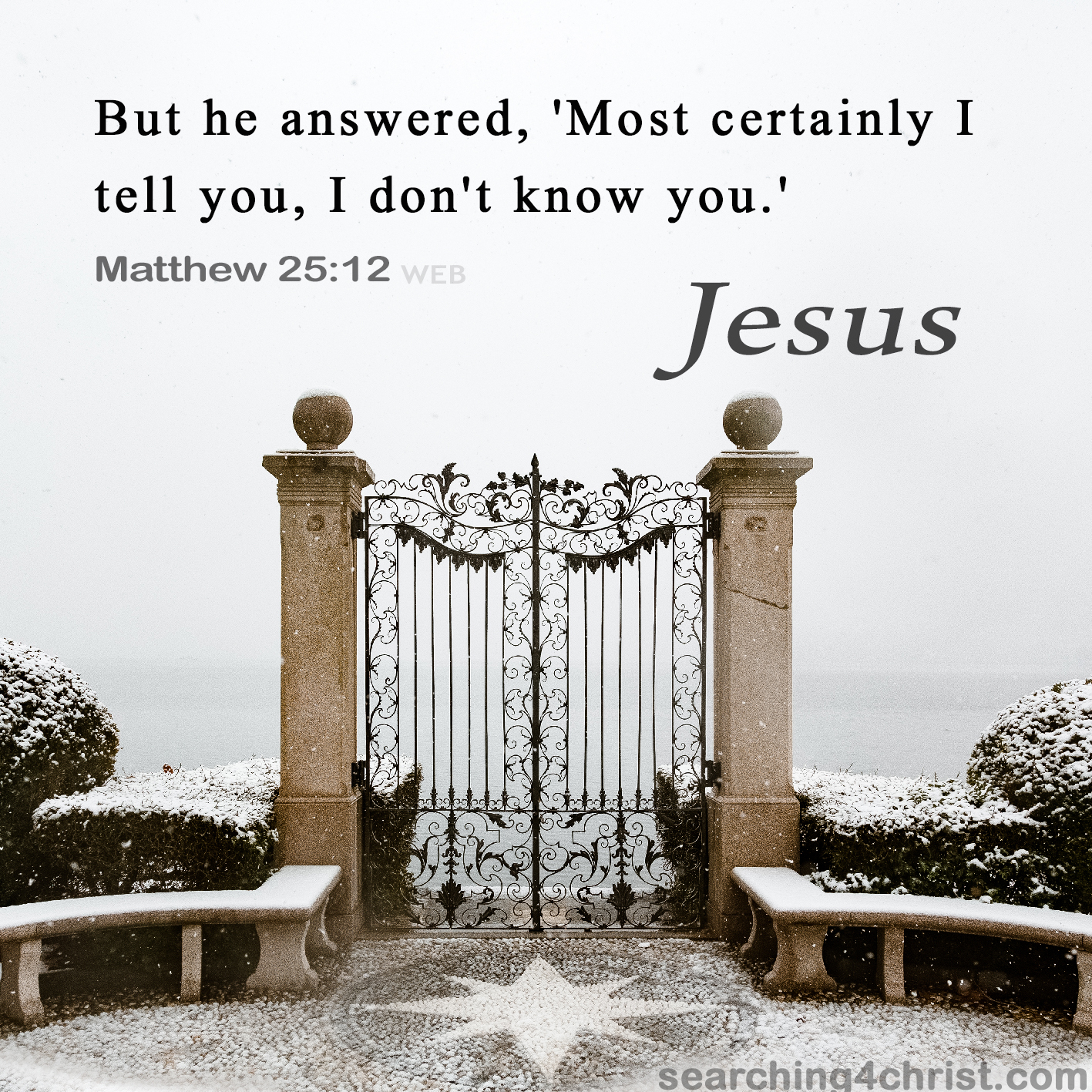
12 “But he replied, ‘Truly I tell you, I don’t know you.’
When the foolish finally arrived, the door was shut. Are we not surprised at that? Many will probably feel that these five were unjustly treated. Why should they not be allowed into the wedding, even if they were a few moments late? This is what I needed to learn and I believe many do not quite understand.
There is no vindictiveness in this shut door. We must be careful that we do not impose our faulty judgments into this matter. What the Lord did was right, and we must be careful to look diligently for those clues that will help us learn why He takes such action as this. There is even a note of sorrow in these words, "I do not know you." Our Lord's words are a faithful, honest revelation of something that had been true all along. Weddings are no place for strangers. Only the friends of the family are permitted to come. So to these five foolish maidens the door is shut for the Lord says, "Truly, I say to you, I do not know you."
With these revealing words from the Lord we can now discover what the oil signifies. Obviously, it was the lack of an adequate supply of oil which caused these foolish maidens to be met with the words, "I do not know you." They did, of course, have some oil when they began but it was not enough. Oil, in the Old Testament, is frequently used as a symbol of the Holy Spirit. Kings and priests were anointed with oil as a sign of their consecrated (and, supposedly, Spirit-filled) lives. Zechariah, the prophet, was shown a vision of a great golden lampstand with two olive trees standing beside it. The trees dripped oil into the bowls of the lampstand, and Zechariah was told: "Not by might, nor by power, but by my Spirit, says the LORD of hosts" (Zechariah 4:6). The oil symbolized the Spirit of God by which the light of testimony could be maintained in the hour of darkness.
Can you see it now? The ministry of the Spirit is to convey to us the knowledge of Jesus Christ. In John 16:13,14, Jesus said of him: "When the Spirit of truth comes, he will guide you into all the truth; for he will not speak on his authority, but...will declare to you the things that are to come. He will glorify me, for He will take what is mine and declare it to you."
The Spirit's task then is to take the Word of God, and through it reveal Jesus Christ. But there are levels of such revelation. There is even a Spirit-born ministry of the word to those who are not true Christians. Jesus revealed this too. "When he comes, he will convince the world of sin and of righteousness and of judgment" (John 16:8). Here is a ministry of the Holy Spirit available to anyone who will seek in the Scriptures to know the truth. But it is designed to take them deeper, into a fuller and permanent relationship that will involve the giving of divine life.
The great danger is that in exposure to the truth of Scripture, in the knowledge of its teaching, we should become satisfied with an intellectual portrait of Christ instead of a living Lord. It is possible to know much doctrine but never to know the Lord. This is the problem with the foolish maidens, who represent those who gladly take enough of the oil of the Spirit to give them immediate help in their problems, or some release from fear or guilt, but who never go on to a surrender of the will to the authority of Jesus Christ.
The foolish, then, are those who have no deeper than a superficial knowledge of scriptural truth. They look for moral enlightenment or for comfort in some hour of uncertainty and doubt. They read to gain reassurance when life seems to be a senseless tangle of threads without apparent purpose. They believe in the Bible but not in the Lord of the Bible. But faith must go deeper than doctrine. Orthodox knowledge is worthless unless it leads to the surrender of self. God freely lights a lamp of knowledge for all who want to know the truth of revelation, but what Jesus indicates here is that there is a deeper level of commitment to the Spirit which is essential to meet the unexpected demands life will thrust at us.
The wise have found that deeper level. They have an extra reservoir of oil which continually feeds the flame of life, never letting it falter or gutter out in darkness, undergirding them in every hour of stress, of pressure or disaster, keeping them firm and steady in the midst of the buffeting pressures of life. They have found a friend who sticks closer than a brother or sister. They have a hidden supply of the mystic oil that lights the flame of life despite the circumstances, and the greater the pressure, the brighter the light shines.
Do you have those friends or family members who call on you to pray for them? Or those who call you their ‘religious friend’? Perhaps you have a friend or family member who will tell you and others that the only way they will get into heaven is due to your prayers. I remember this scripture being the one that changed me forever because I never wanted to hear the Lord say that He didn’t know me. That is when I finally understood the term “personal relationship with the Lord.”
Are you at the end of your rope? This is the end of a strange and difficult year. Are you seeking something greater and are you seeing that light in a family member or friend, or someone at church? Is it so appealing that you are saying, "Give me of your oil." That cannot be done. The granting of the Spirit's power to an individual is marked "Nontransferable." He cannot share it with anyone else. It has been said that there are only two ways to take a thing seriously: either to renounce it or to risk everything upon it. Is this not what Jesus meant when he said, "Whoever would save his life will lose it, and whoever loses his life for my sake will find it" (Matthew 16:25)?
There are some who want a third choice, who are continually seeking to make a partial commitment, who try to find a compromise arrangement with God in which they may subscribe to the truth of Scripture but refuse to let it change their activities or their attitudes. That third alternative simply does not exist. That is what Jesus is saying here. That is why he says plainly to the foolish maidens, "Truly, I say to you, I do not know you." The end shows them for what they are. The door is shut, both to the unbeliever who never tried to get in and to the foolish person who never took God seriously.
This passage changed my life forever! If you are struggling to understand, please do not leave! Keep coming back here. God does not want you to grow weary. Keep on seeking! Take this time to ask God for His Spirit to reveal more to you. From the bottom of my heart, I pray that you would receive this amazing gift of life and never worry about hearing, “I never knew you.”
Blessings,
Lisa


